
Milan Design Week remains the primary reference point for the global design industry. What we see at the Fuorisalone doesn't just indicate trends, it dictates the sensory vocabulary of our projects for the next several years.
In 2026, the shift is away from the object and toward the atmosphere. The official theme, Be the Project, moved the focus from the finished product to the human ritual. We’ve filtered the week’s events to bring you the defining moments - and the specific shifts in materiality that actually matter for your next specification.
Highlights
Installations That Took Over the City
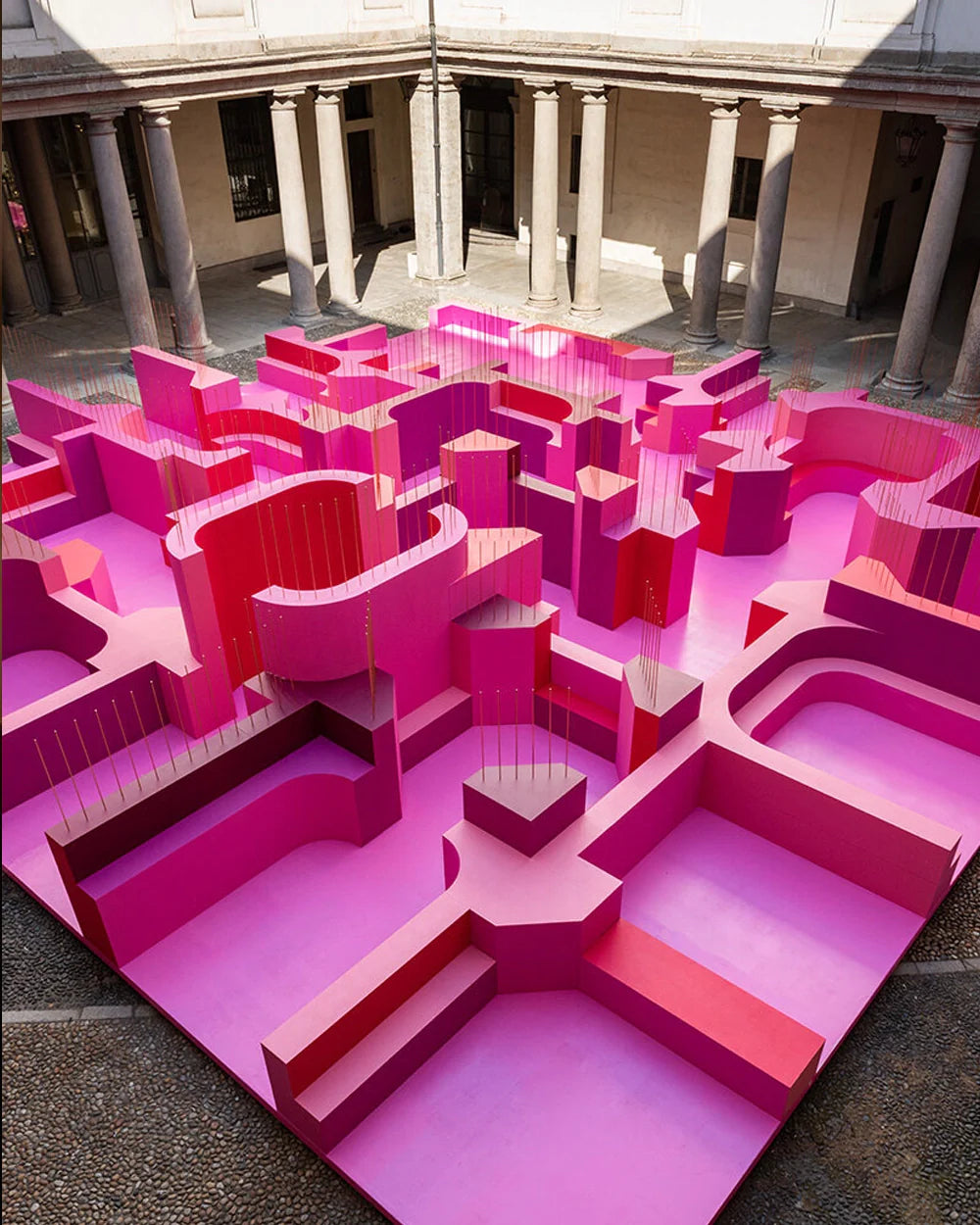
The 2026 edition was defined by a sense of play and visceral connection. Across the city’s historic courtyards, large-scale installations moved away from static statements toward multi-sensorial environments in bold colours that required active participation.
The Viral Highlights
The week’s most-photographed moments focused on the human pulse.
Sara Ricciardi’s "Serotonin" at the Pinacoteca di Brera utilised giant inflatable modules that expanded and contracted in a rhythmic "breath," exploring how beauty influences our physical responses.

Serotonin - The Chemistry of Happiness, Sara Ricciardi’s immersive installation at the Pinacoteca di Brera. Image: Designboom.

L: Metamorphosis in Motion by Lina Ghotmeh. R: Puffy Summer designed by Andy Hillman. Images: Abitare.
At Palazzo del Senato, Škoda’s "Ooooh, that’s EpiQ!" installation - a collaboration with Ricardo Orts of Ulises Studio - blended automotive innovation with architectural play, using soft, plasticine-inspired volumes to rethink urban mobility.

The immersive installation at Palazzo del Senato showcased Škoda’s current design approach and the camouflaged Škoda Epiq. Image: Škoda.
For those tracking the intersection of media and design, the Designboom x La Marzocco "Room for Dreams" hub at ME Milan Il Duca served as the week’s central venue for sensory dialogue and cinema.
From Object to Atmosphere
The broader material trend was a return to "honest surfaces". We saw this in the "Interior Reflections" installation by Studiopepe at Mohd Officina (together with Parachilna unveiling the new Klara collection) which transformed a former workshop into a layered domestic landscape of surfaces and contrasts.

Mohd Home Design presents Interior Reflections - a collaboration with Parachilna celebrating the debut of the Klara collection. Image: Mohd.
This tactile direction was mirrored across the city: at Spazio Maiocchi, IKEA’s PS 2026 Easy Chair reimagined the inflatable trend with a technical steel frame, while Hermès at La Pelota showcased the Confettis Basket in a display of leather craftsmanship.
In lighting, Preciosa’s "Drifting Lights" used 3D effects to make light behave like fluid ink, and Aesop’s "Factory of Light", designed by March Studio, utilised 16,000 amber bottles to debut their Aposē collection.


Top: Drifting Lights by Preciosa. Left: Aesop's Factory of Light. Right: Bocci's Light as Medium.
Even the Bocci installation at Via Giuseppe Rovani 20 reinforced this direction, treating light as a structural volume rather than a simple utility.

Lighting as a Material
How do these global shifts change the way we specify? For the Nook community, it’s about emotional frequency - how a pendant anchors a room when it’s switched off and how it defines the eye's path when it’s on.
Artemide and the Dialogue Between Structure and Perception

"Light Knot Progression" by BIG (Bjarke Ingels Group). Image: urdesign.
Artemide remains the industry benchmark for human-centric innovation. Their 2026 showcase featured the monumental "Light Knot Progression" by BIG (Bjarke Ingels Group). A 280-meter continuous line of light winding through the historic Filarete portico.

Ulrich und Diotima by Artemide
They also announced the launch of Ulrich und Diotima, designed by Carlotta de Bevilacqua, which represents a notable shift in materiality. A minimalist, architectural base supports a sphere of craquelé blown glass, shaped through thermal shock to produce a network of micro-fractures. The surface refracts light into ever-changing patterns, while integrated mains-voltage LEDs keep the object visually pure.

The Ruby Red Collectionby Artemide
We also saw the launch of the Ruby Red Collection, a limited-edition collaboration between Artemide and Danese Milano that reinterprets their most recognisable icons. In this series, colour isn't treated as a finish but as a structural tool. By applying a deep, glossy and saturated red to timeless forms, the collection reshapes our perception of the objects themselves.
The result is a sharpening of identity; familiar silhouettes take on a more radical, physical presence in the room. This bold use of a single, expressive shade intensifies the relationship between the light source and its environment, proving that color can be used to specify not just a look, but an immediate emotional condition within a space.
Parachilna and Seamless Diffusion
Building on the partnership seen at MOHD, Parachilna offers a sense of permanence and craft that mass-produced alternatives cannot match. The standout release was Klara, a new collection designed by Joshua Linacisoro.

Klara by Parachilna
The design features a glass tube supported by a brass structure finished in graphite. Technically, it is a study in seamless diffusion; it utilises a custom 2700K LED ring encased in a silicone housing that acts as both the joining component and the diffuser. Whether it’s the new Klara or the iconic Gweilo, Parachilna remains the human pulse of design, offering a level of craft that anchors the connected environments of the future.
Lodes and Invisible Architecture

The Axia Pendant Light by Lodes
Lodes has solved a long-standing visual hurdle with the Axia Pendant. Designed by Vittorio Venezia and Carolina Martinelli, it reinterprets the chandelier by using its central axis as the electrical conductor. By conducting power through the structure itself, they’ve removed the need for visible wiring. Axia is a technical achievement that allows for a large-scale focal point that feels impossibly light and uncluttered.
Karman and Theatricality

The Alibaglass Pendant Light now introduced in black, unveiled at Milan Design Week
Karman’s 2026 collection leans into theatricality through material soul. The Alibaglass series by Matteo Ugolini reimagines their signature form in deep, smoke-tinted borosilicate glass. It functions as a material statement by day and a quietly dramatic light source by night - ideal for hospitality projects where the atmosphere must shift with the clock.
Audo Copenhagen and the New Quiet


Left: Hashira Portable Table Lamp Right: Hashira Cluster Pendant Light
Audo Copenhagen continues to lead the move toward the "New Quiet." The latest iterations of the Hashira Collection utilise textured linen and wood to soften the edges of a room. These are pieces designed for the human ritual of space, providing the sense of calm and intimacy that defined the best moments of the 2026 fair.
Beyond Milan
Milan 2026 signalled a move from function to feeling. As you look toward your next project, think beyond the bulb. Focus on the process, the material, and the resonance.
We believe the future isn't just seen, it's felt.